
What Is a PST File?
PST stands for Personal Storage Table. It is how Microsoft Outlook stores your emails, contacts and calendar items in a single file on your computer. If someone exported their mailbox or if you recovered a PST file from an old hard drive, you need a way to read it.
The problem: PST is a proprietary Microsoft format. You cannot just double-click it and read the contents. You need either Microsoft Outlook or a third-party viewer.
ANSI vs Unicode: the PST format gotcha
Microsoft shipped two PST format revisions, and it matters when you pick a viewer. ANSI PST (Outlook 2002 and earlier) caps at 2 GB, uses a single-byte character set that mangles international text, and carries a wVer header of 14 or 15. Unicode PST (Outlook 2003 with the Unicode option, Outlook 2007 and later, Microsoft 365) allows up to 50 GB, holds the full Unicode character set, and reports a wVer of 23 or 36. Many viewers read only the Unicode format and either fail silently or throw a misleading error on an older ANSI file, so confirm your tool handles both before you conclude a PST is corrupt.
Method 1: Use Sherlock Forensics PST Viewer (Recommended)
The fastest way to open a PST file without Outlook. Free, no signup and no Outlook license required.
Step-by-step
- Download the viewer. Get Sherlock Forensics PST Viewer from our product page. It is a single .exe file (33 MB). No installer needed.
- Run the application. Double-click the downloaded file. No installation or account creation required.
- Open your PST file. Click the Open File button in the toolbar. Browse to your PST file and select it.
- Browse your emails. The folder tree appears on the left. Click any folder to see its emails. Click an email to read it. Attachments show below the message body.
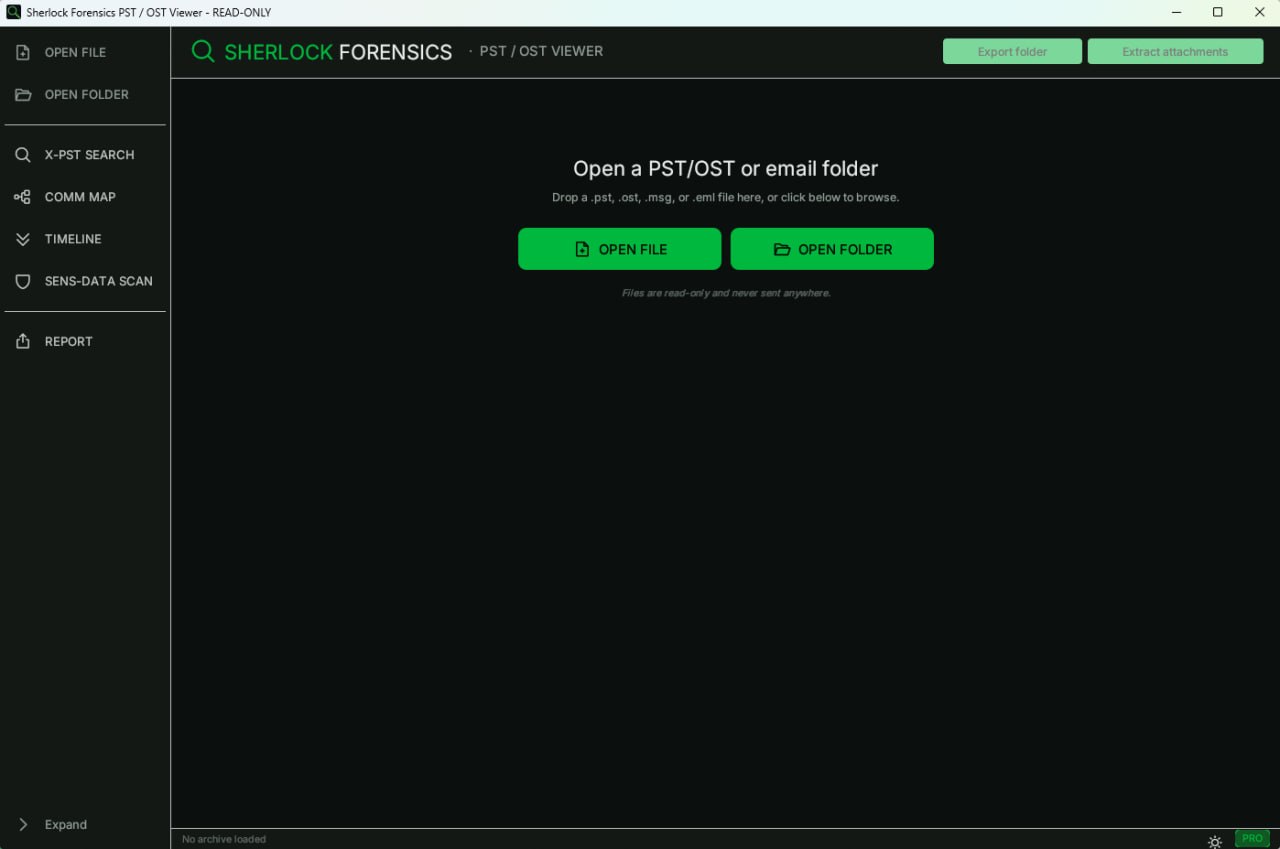
Sherlock Forensics PST Viewer - click to enlarge
The viewer also opens OST files (Outlook cached mailboxes), MSG files (individual Outlook messages) and EML files (standard email format).
If you need to recover deleted emails or export messages to PDF, the Forensic Edition is $67 one-time with no subscription.
Method 2: Import Into Outlook (If You Have It)
If you already have Microsoft Outlook installed, you can import a PST file directly:
- Open Outlook and go to File > Open & Export > Import/Export.
- Select Import from another program or file.
- Choose Outlook Data File (.pst).
- Browse to your PST file and select it.
- Choose whether to import into your current mailbox or open as a separate folder.
The catch: this requires an Outlook license. Microsoft 365 starts at $150+ per year. If you just need to read a PST file once, that is expensive.
Method 3: Online PST Viewers
Several websites offer browser-based PST viewing. You upload your PST file and read it in the browser.
The privacy concern: PST files contain personal emails, attachments and contact information. Uploading them to a third-party server means that server now has a copy of your email data. For anything work-related, legal or confidential, this is a bad idea.
A desktop viewer like Sherlock Forensics PST Viewer keeps everything on your computer. Nothing gets uploaded anywhere.
Which Method Should You Use?
| Method | Cost | Privacy | Best for |
|---|---|---|---|
| Sherlock Forensics PST Viewer | Free | Local only | Anyone without Outlook |
| Import into Outlook | $150+/year | Local only | Existing Outlook users |
| Online viewers | Free | Uploaded to server | Non-sensitive personal files |
Need forensic-grade analysis with chain of custody and hash verification? Read our guide for investigators. Comparing PST viewers? See our full feature comparison. Need to open suspicious PDFs safely? See our guide to opening unknown PDFs.
Frequently Asked Questions
Can I open a PST file on Mac?
Not natively. PST is a Windows format. On a Mac you can run Windows in a virtual machine (Parallels or VMware Fusion) and use a PST viewer there. Some web-based viewers work on Mac but require uploading your email data to a third-party server.
What is the difference between PST and OST?
PST (Personal Storage Table) files are standalone email archives you can copy and move between computers. OST (Offline Storage Table) files are cached copies of a mailbox tied to a specific Outlook profile. Both contain emails, contacts and calendar items. Sherlock Forensics PST Viewer opens both.
Is it safe to open someone else's PST file?
Yes. Opening a PST file in a viewer is read-only. The file is not modified in any way. Sherlock Forensics PST Viewer never writes to the source file, so the original data stays exactly as it was.
Can I recover deleted emails from a PST file?
Sherlock Forensics PST Viewer's free version opens and searches the PST archive without Outlook. Deleted-item recovery (four carving methods, confidence ratings and export) is the Forensic Edition ($67 one-time). Most competitors do not offer it at any price.