
Per-Artifact Deep Dive

Recover Deleted iPhone Photos: The Honest Version

Some deleted photos come back and some are gone for good. A credible tool tells you which and flags what it recovered so a courtroom can trust it.

Sherlock Forensics iPhone Analyzer recovers Recently Deleted media still present, surfaces hidden albums and carves deleted photo records from freed SQLite pages where they survive. Recovered items are flagged as recovered, distinct from live media. Photos the device has already purged are gone. The tool says exactly that. Works from a backup or a full-filesystem extraction. $599 one-time.

Windows 10/11 | One-time license | Works from a backup or extraction | 100 percent read-only

The Real Question

Deleted, Hidden, Purged: Three Different Things

The question of whether deleted iPhone photos can be recovered has one honest answer: it depends entirely on what state the photo is in. Conflating three different states is where dishonest tools and overhopeful claims go wrong. Sherlock Forensics iPhone Analyzer handles each for exactly what it is.

Hidden photos are not deleted at all. They are moved to a hidden album, still fully present on the device, so Sherlock surfaces them plainly. Recently Deleted photos sit in a holding album for roughly 30 days before iOS clears them; while they remain they are recovered in full with their metadata. Purged photos, past that window and cleared from the library, are the hard case: what survives then is only what freed-page carving can pull from the database before those pages are reused. Naming the state is the first honest step; the recovery claim follows from it.
Carving

What Freed-Page Carving Actually Recovers

The photo library is tracked in SQLite databases, the same structure that holds messages and calls. When a photo record is deleted, iOS marks its database page as free rather than erasing it on the spot. Until the database writes new data over that page the deleted record is physically still there. Sherlock carves those records back out through standard freed-page carving, the same methodology it applies across the iOS artifact set.

What survives is a function of time and device use after the deletion, not a tool setting. A photo deleted and purged an hour before acquisition on a lightly used phone is often recoverable; the same photo deleted months ago on a busy device has usually been overwritten and is gone. This is physics that applies to every forensic tool equally. What separates a credible one is that it recovers what is actually there, flags it as recovered and reports honestly on the rest rather than fabricating records to look thorough.

One nuance worth understanding is that carving often recovers the record before it recovers the pixels. A carved database row can return a photo's filename, its capture timestamp, its GPS coordinates and its album membership even when the underlying image file itself has already been reclaimed. For an investigation that is frequently enough: the fact that a photo with a specific timestamp and location once existed on the device and was then deleted can be the material point in itself, regardless of whether the image ever renders. Sherlock presents the recovered record and whatever media survives with it, staying explicit about which of the two a given result is, so an examiner never implies a picture exists when only its metadata came back.

Any Source

Reachable From a Backup or an Extraction

Recently Deleted media, hidden albums and freed-page carving all work from an encrypted logical backup as well as a full-filesystem extraction, so deleted-photo recovery does not require enterprise acquisition tooling. Point Sherlock at a backup you make from an unlockable device, an existing iTunes or Finder backup or a Cellebrite UFED or VeraKey full-filesystem extraction. A full-filesystem extraction reaches deeper into hidden and deleted media that a logical backup does not carry, but the core recovery is available whichever way the evidence arrived.

Beyond the Image

A Recovered Photo Carries Its Time and Place

A deleted photo is often most useful for more than what it depicts. Recovered media carries its capture GPS and EXIF where present, so a photo comes back with the time it was taken and, frequently, the place. That turns a single recovered image into a dated whereabouts point that plots on the offline map and feeds the merged Activity Timeline alongside messages, locations and app activity. In many matters the metadata on a deleted photo settles a timeline question the image itself only hints at.

The same honesty applies to the metadata as to the pixels. Sherlock reports the capture data the file actually carries and does not infer a time or place that is not recorded. A recovered photo without embedded location is presented as exactly that, a photo without a recorded place, not a gap the tool papers over.

See It

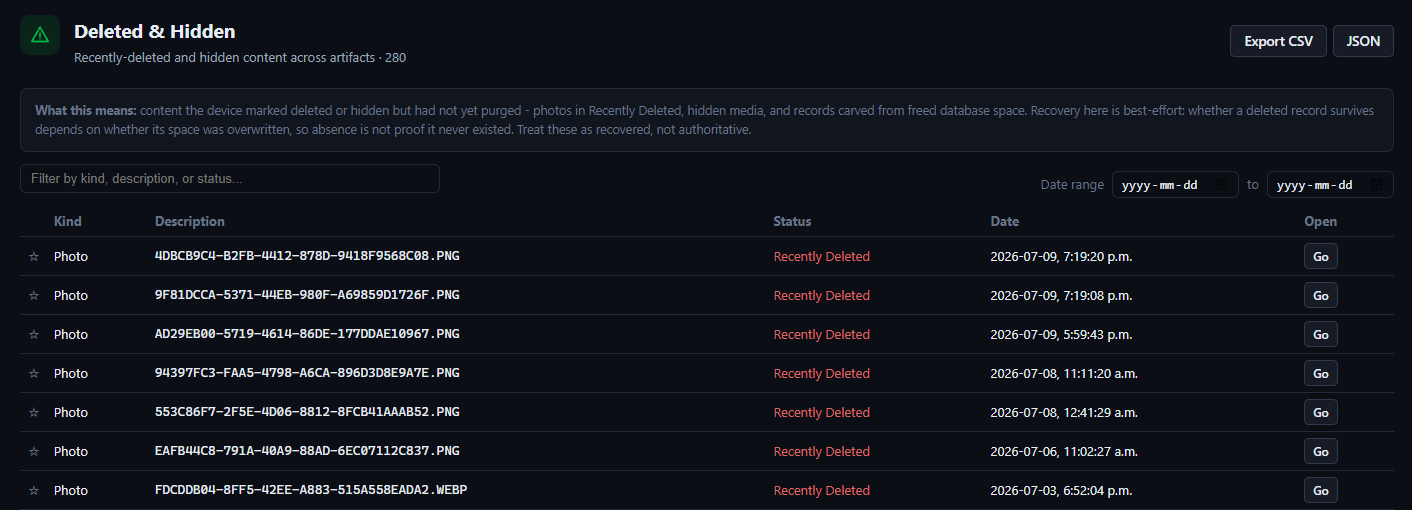
Sherlock Forensics iPhone Analyzer deleted and hidden media recovery view with carved records flagged as recovered
Deleted and hidden media, with recovered records flagged distinct from live photos

Court-Ready

Recovered and Labeled as Recovered

The single most important discipline in deleted-media evidence is keeping recovered items visibly distinct from live ones. Sherlock flags every carved and Recently Deleted item as recovered in the interface and in the court report, so an examiner never presents a carved photo as a live one and can testify precisely to each item's state. Analysis is 100 percent read-only; the evidence is never modified.

The court-ready HTML report documents case and evidence numbers, examiner identification, disclosed methodology, per-artifact SHA-256 hashing and an optional evidence-integrity manifest, the documentation elements described in NIST Special Publication 800-101 Revision 1, Guidelines on Mobile Device Forensics. Built by CISSP, ISSAP and ISSMP certified examiners with 20 years of court-defensible practice.

Honest Scope

What This Analysis Is and Is Not

Sherlock recovers what the evidence still holds: Recently Deleted and hidden media present in the backup or extraction, along with records carved from freed pages that have not been overwritten. It does not recover photos the device has already purged and overwritten, does not reconstruct an image from nothing and does not reach iCloud Photos that never synced to the device. It reads a device you can unlock, an existing backup or a Cellebrite UFED or VeraKey extraction. The honest limit is the product: a straight account of what survived is worth more in court than an inflated promise.

Questions

Deleted iPhone Photo FAQ

Can Sherlock recover deleted iPhone photos?
Some of them. The tool is honest about which do come back. Recently Deleted media still present in the evidence is recovered, hidden albums are surfaced and photo records carved from freed SQLite pages are returned where the freelist has not overwritten them. Photos the device has already purged are gone; Sherlock flags what it recovered rather than promising everything.
What is the difference between deleted, hidden and purged?
Hidden photos are still on the device, just moved to a hidden album that Sherlock surfaces. Recently Deleted photos sit in a holding album for about 30 days and are recovered while they remain. Purged photos, past that window and cleared, are removed from the library; what survives then is only what carving can pull from freed database pages before they are reused.
How does freed-page carving work for photos?
The photo library is tracked in SQLite databases. When a record is deleted, iOS marks its database page as free rather than erasing it. Until new data overwrites that page the deleted record is still physically present. Sherlock carves those records back out. Recovery depends on how heavily the device was used after the deletion, which is physics, not a tool setting.
Do I need a full-filesystem extraction to recover deleted photos?
No. Recently Deleted and hidden media and freed-page carving work from an encrypted logical backup as well as a full-filesystem extraction. A full-filesystem extraction reaches deeper into hidden and deleted media on the device, but the core deleted-photo recovery does not require one.
Are recovered photos marked as recovered?
Yes. Carved and Recently Deleted items are flagged as recovered in the interface and in the court report, distinct from live media, so an examiner can distinguish a live photo from a carved one on the stand. That distinction matters more to a case than a larger unqualified recovery number.
Is recovered photo evidence court-defensible?
Analysis is read-only and the court-ready report documents examiner details, methodology and per-artifact SHA-256 hashing, with recovered media flagged throughout. Photos carry their capture GPS and EXIF where present. Admissibility depends on jurisdiction, authority and evidence handling; the report documents the record for testimony.

Start Now

See What Survived in Your Evidence

Download the free edition, open a backup or extraction and see the Recently Deleted, hidden and carved media in your own evidence for yourself. Unlock the full recovery when the case calls for it: $599 one-time, no subscription.

Get Sherlock Forensics iPhone Analyzer

Related: iPhone forensics fact checks · iMessage forensics · Significant Locations forensics · Product page