
Per-Artifact Deep Dive

Bluetooth Device History: The Company a Phone Keeps

The devices an iPhone paired with are quiet association evidence. Here is what the Bluetooth record holds, why it requires a full-filesystem extraction and how it reaches a courtroom.

Sherlock Forensics iPhone Analyzer reconstructs the iPhone Bluetooth and BLE device history: the devices the phone paired with or connected to, with their names, identifiers and connection times. It reads this system record from a Cellebrite UFED or VeraKey full-filesystem extraction, not a logical backup, then presents it as device-association evidence rather than proof of a person. $599 one-time; the free edition previews it first.

Windows 10/11 | One-time license | Full-filesystem extraction | 100 percent read-only

The Artifact

What the Bluetooth Record Holds

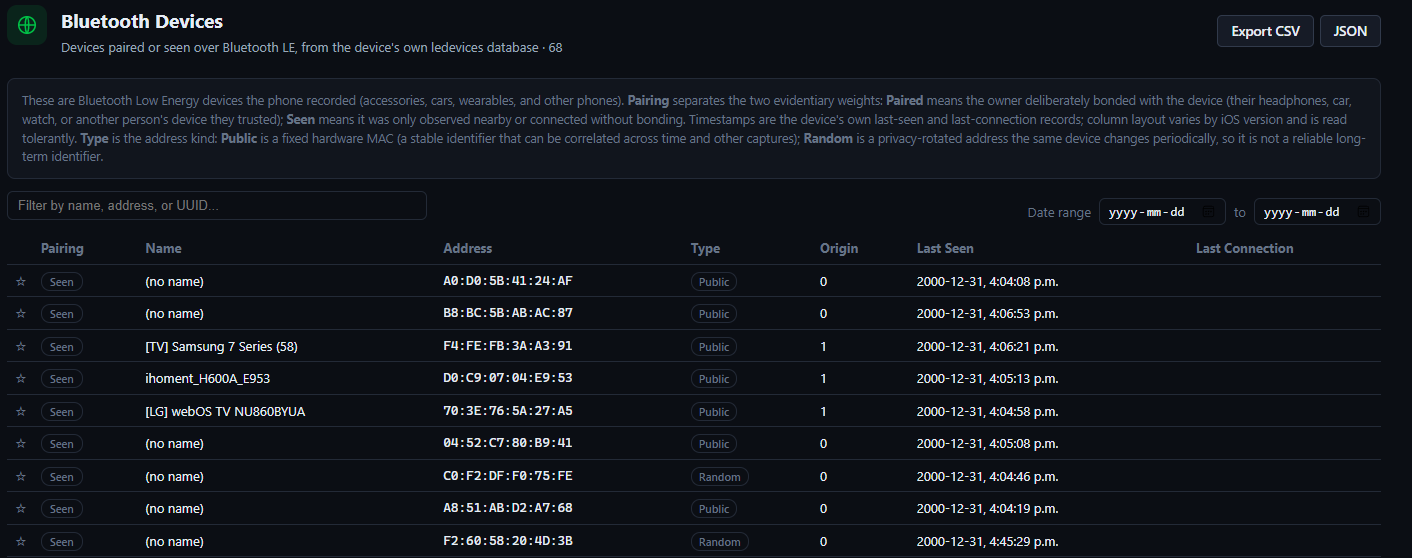
Every iPhone keeps a record of the devices it has met over Bluetooth and Bluetooth Low Energy. Car kits, wireless headphones, speakers, smart watches, fitness bands, other phones and a long tail of accessories all leave a trace when a phone pairs with or connects to them. Sherlock Forensics iPhone Analyzer reconstructs that record into a searchable view: the devices in the phone's Bluetooth history with their names, their identifiers and the connection times the system retained.

This is one of the artifacts that separates a real forensic analysis from a photo-and-message dump. The Bluetooth record is not about content at all. It is about association, the objects and other devices a phone has been close enough to connect with. A pairing with a specific vehicle can tie a device to a car. A wearable can tie it to a person's daily kit. Another individual's phone in the paired list can corroborate that two devices were once in the same place. None of that shows up in messages, which is exactly why the Bluetooth view earns its place in a thorough examination.

Read across the merged Activity Timeline, a connection time becomes part of a sequence rather than a bare entry. A Bluetooth event that lines up with a call, a location or a message from the same window turns a list of device names into corroboration. Global search runs across the Bluetooth record with the rest of the device, so an identifier or a device name can be traced wherever else it appears.
Source Scope

Why This One Needs a Full-Filesystem Extraction

Not every artifact is reachable the same way. Being honest about that is part of a defensible tool. The system Bluetooth records sit outside the app data that a logical backup captures, so this artifact requires a Cellebrite UFED or VeraKey full-filesystem extraction. A standard iTunes or Finder backup does not carry the system Bluetooth history. Sherlock states that plainly rather than implying a backup would surface it, because a report that overreached on source would not survive scrutiny.

That places Bluetooth device history in the deeper tier of the examination, the behavioral and system artifacts a full-filesystem extraction opens up. Where a case already has a Cellebrite or VeraKey image, the Bluetooth record is right there to work. Where the evidence is only a logical backup, an honest analysis says the system Bluetooth history is not in scope for that source and points to what the backup does carry instead.

See It

Sherlock Forensics iPhone Analyzer Bluetooth device history view showing paired devices, names and identifiers from a full-filesystem extraction
Paired and connected devices with names and identifiers from a full-filesystem extraction

The Honest Limit

Association, Not a Person

The discipline that makes Bluetooth evidence useful is the discipline that keeps it honest: it attributes to a device, not to a person. A pairing shows that the iPhone connected to another device, not who was holding either one. That distinction is not a weakness; it is what lets the evidence stand. An examiner presents a pairing with a car kit or a wearable as corroboration that two devices were associated, then lets the rest of the record, the calls, the locations and the messages, carry the question of who was there.

Sherlock frames the Bluetooth record that way throughout, in the interface and in the report. It surfaces the devices and the timing the extraction preserved and it reports what is present rather than inferring continuous tracking the artifact does not support. That restraint is what an opposing expert tests, so the tool is built to state exactly what a Bluetooth association does and does not prove.

Court-Ready

From the Pairing to the Report

Association evidence has to be documented carefully because it is easy to overstate, so the report is built for restraint: the court-ready HTML report carries case and evidence numbers, examiner identification, disclosed methodology, per-artifact SHA-256 hashing and an optional evidence-integrity manifest, with the Bluetooth entries described as device-association evidence, the documentation practice set out in NIST Special Publication 800-101 Revision 1, Guidelines on Mobile Device Forensics. Analysis is 100 percent read-only; the evidence is never modified.

Built by CISSP, ISSAP and ISSMP certified examiners with 20 years of court-defensible practice. Admissibility depends on jurisdiction, authority and evidence handling; the report documents the record so testimony rests on it rather than on recollection.

Honest Scope

What This Analysis Is and Is Not

Sherlock reads the Bluetooth device record from a full-filesystem extraction produced by acquisition tooling. It does not unlock a locked device, does not bypass a passcode and does not surface the system Bluetooth history from a logical backup that never carried it. It reports device associations, not the identity of any person. It surfaces the timing the extraction retained rather than inferring movement the record does not hold. Sherlock reports what the acquired evidence carries and describes it for exactly what it is, which is what an examiner can defend on the stand.

Questions

Bluetooth Device History FAQ

What Bluetooth history does Sherlock recover from an iPhone?
Sherlock Forensics iPhone Analyzer reconstructs the Bluetooth and BLE device record: devices the iPhone paired with or connected to, their names, their identifiers and the associated connection times. Car kits, wearables, headphones, speakers and other phones or accessories surface as a list of the devices in the phone's Bluetooth orbit.
Does Bluetooth history need a full-filesystem extraction?
Yes. The system Bluetooth records live outside the app data that a logical backup captures, so this artifact requires a Cellebrite UFED or VeraKey full-filesystem extraction. A standard iTunes or Finder backup does not carry the system Bluetooth history. The page states that plainly.
Is Bluetooth history proof that a person was somewhere?
No. Bluetooth history is device-association evidence: it shows that the iPhone paired with or connected to another device, not who was holding either one. It is strong corroboration, a phone associated with a specific car kit or wearable, but it attributes to the device, not to a person. An honest report frames it that way.
Why does Bluetooth device history matter in a case?
It establishes associations that other artifacts do not. A pairing with a particular vehicle, a wearable or another individual's device can place two devices in proximity, corroborate a relationship or a movement or contradict an account. Read across the timeline, connection times line up with calls, messages and locations from the same window.
Can Sherlock show when a device last connected?
Where the extraction preserves connection timestamps, Sherlock surfaces them, so an examiner can see the devices in the phone's Bluetooth history and the timing the records retained. The available detail depends on what iOS and the extraction kept; Sherlock reports what is present rather than inferring beyond it.
Is Bluetooth evidence court-defensible?
Analysis is read-only and the court-ready report documents examiner details, methodology and per-artifact SHA-256 hashing, with device-association evidence described as such. Admissibility depends on jurisdiction, authority and evidence handling; the report documents the record for testimony.

Start Now

See the Bluetooth Record in Your Evidence

Download the free edition, open a full-filesystem extraction and read the Bluetooth device history yourself. Unlock the full analysis and the court-ready report when the case calls for it: $599 one-time, no subscription.

Get Sherlock Forensics iPhone Analyzer

Related: Read a Cellebrite UFED extraction · iPhone full-filesystem analysis · Significant Locations forensics · Product page